
Background and cause of the 2025 conflict
- Trigger incidents (May-July 2025): Tensions, which had been rising since May, came to a head on July 23 after five Thai soldiers were injured by a landmine. This was followed by diplomatic downgrading and accusations of freshly laid mines by Thailand, which Cambodia denied.
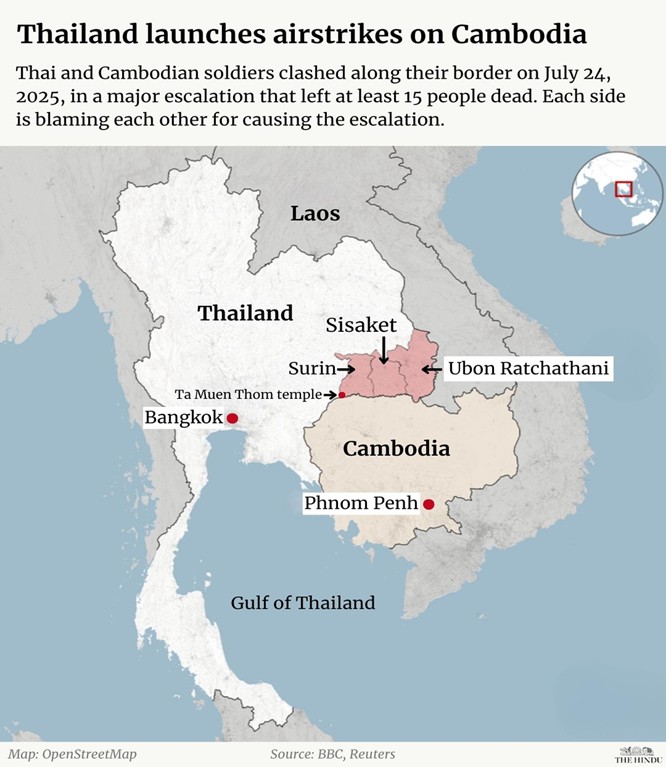
- Escalation (July 24, 2025): Full-scale fighting broke out on July 24 near the Prasat Ta Muen Thom temple, involving artillery and airstrikes.
- Wider conflict (July 24–27, 2025): Clashes spread to at least 12 border locations over the next few days, displacing hundreds of thousands of civilians. Thailand reported attacks across several provinces, including Surin, Ubon Ratchathani, Chanthaburi, and Trat.
- Disputed sites: While skirmishes occurred in multiple areas, the key disputed temple sites are:
- Preah Vihear Temple: An 11th-century Hindu temple dedicated to Lord Shiva, located atop a cliff in the Dangrek Mountains. The International Court of Justice (ICJ) awarded ownership to Cambodia in 1962 and reaffirmed this in 2013, but the land surrounding it remains contested by Thailand.
- Prasat Ta Muen: Thom Temple Complex: This 12th-century temple complex is also a key point of contention where some of the July 2025 clashes took place.
Ceasefire and regional involvement
- Ceasefire agreement: Following intense fighting, both nations agreed to an unconditional ceasefire on July 28, 2025, after talks in Kuala Lumpur.
- Mediation: The talks were mediated by Malaysian Prime Minister Anwar Ibrahim, with encouragement from the United States and China.
- ASEAN’s role: The crisis highlighted the limitations of the Association of Southeast Asian Nations (ASEAN) conflict-prevention mechanisms, prompting calls for the regional body to take a stronger role in resolving historical conflicts.
Explanation of Exam Oriented Key Terms
01Preah Vihear Temple |
Preah Vihear Temple is a Khmer Empire-era Hindu temple on the Dangrek Mountains, dedicated to Lord Shiva, and a UNESCO World Heritage Site known for its unique linear design, culminating in a central sanctuary at the summit. It is also at the heart of a territorial dispute between Cambodia and Thailand, with the International Court of Justice (ICJ) ruling it belongs to Cambodia in 1962 and again in 2013, though border tensions persist. Location and historical context
Architectural features
International dispute and rulings
|
 Current Affairs
 Contemporary Issues
 Subject Wise
  Essential Editorials