Pacific Microstate Sells First Passports To Fund Climate Action


Nauru launched a “climate resilience citizenship” program in early 2025 to sell passports for at least $105,000 each, aiming to fund climate action and potential relocation due to rising sea levels. Despite slow initial uptake, with only six applicants approved by early August 2025. The funds are intended to create a sustainable future for the nation and help cover relocation costs for its citizens. 

Overview of the citizenship program
  •  Purpose: The Economic and Climate Resilience Citizenship Program (ECRCP), launched in February 2025, is a “golden passport” scheme designed to fund Nauru’s climate adaptation efforts. The funds are intended to finance projects, including the relocation of 90% of the island’s population to higher ground due to rising sea levels.
  • Cost: A single applicant must make a minimum contribution of $105,000, plus various fees. The total minimum cost is about $130,000.
  • Goals: Nauru’s initial target was to raise over $5 million in the first year by selling 66 passports. In August 2025, officials reported that a German family was among the first six approved applicants, contributing about $140,000 toward climate projects. Long-term plans aim to generate $60 million annually.
  • Benefits: In exchange for the investment, applicants receive a Nauruan passport, which provides visa-free access to approximately 89 countries, including the UK, UAE, and Singapore.
Explanation of Exam Oriented Key Terms
01
About Nauru

Nauru is a microstate in the southwestern Pacific Ocean, known for its extensive phosphate deposits that were mined until the 1990s.

Geography and Environment
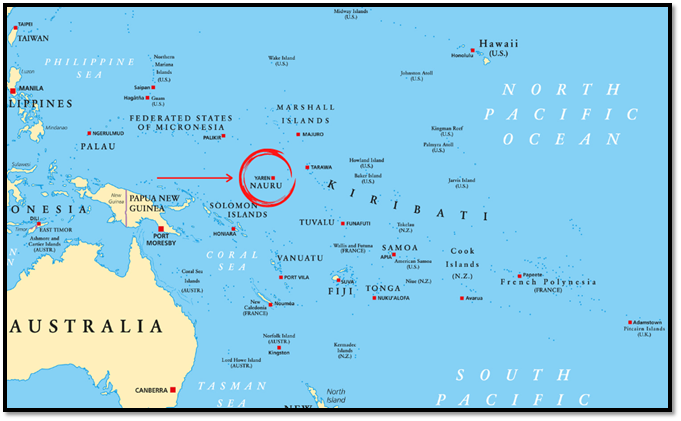
  • Location: A small island nation in the southwestern Pacific Ocean, approximately 1,300 km northeast of the Solomon Islands. Its closest neighbor is Banaba Island in Kiribati, about 300 km to the east.
  • Topography: A raised, fossilized coral atoll and one of the three great phosphate rock islands in the Pacific.
  • Phosphate mining: Extensive phosphate mining has left the interior of the island largely uninhabitable and uncultivable.
  • Climate: Hot and humid year-round due to its equatorial location.
  • Smallest nation: It is the third-smallest country in the world and the smallest island nation.
  • Capital: Nauru has no official capital; the Yaren district is the de facto capital.
Politics and Governance
  • Government: A republic with a Westminster-style parliamentary system. The president is both head of state and head of government.
  • Independence: Gained independence in 1968.
  • International memberships: A member of the United Nations and the Commonwealth of Nations.
Economy and Society
  • Currency: Uses Australian currency as its legal tender.
  • Language: Nauruan is the native language, but English is widely spoken.
  • Current affairs: Nauru has recently started a “golden passport” program to sell citizenships to fund climate action, including relocating people from coastal areas.
India-Nauru Relations
  • Diplomatic relations: Established in 1981, with diplomatic ties coordinated through the Indian High Commission in Suva, Fiji.
  • Areas of cooperation: Includes development assistance, climate change, IT, defence, and trade.
  • COVID-19 assistance: India provided medical assistance and vaccines during the pandemic, including the gifting of Covishield vaccines in 2021.

PRACTICE QUESTIONS

With reference to the “Economic and Climate Resilience Citizenship Program” launched by the Pacific nation of Nauru, consider the following statements:

I. The program was initiated to fund climate adaptation and mitigation efforts, particularly to counter threats from rising sea levels

II. The initial uptake for the program has been slow, with only a handful of applicants approved since its launch

III. The program includes the option for a non-refundable contribution and requires applicants to have prior business investment in Nauru

IV. Nauru is the first country to launch such a program to fund climate resilience initiatives

Which of the statements given above are correct?

a) I and II only
b) I, III and IV only
c) I, II and III only
d) I, II, III and IV

Answer: a

Explanation: Statement I is correct- Nauru’s program, also called the “Climate Resilience Citizenship Program,” was created to fund climate action, including adaptation and mitigation initiatives. The nation is a low-lying island highly vulnerable to rising sea levels. Statement II is correct- News reports indicate that only a small number of applicants have been approved since the program started in February 2025, highlighting a slow initial uptake despite official optimism. Statement III is Incorrect- The program involves a non-refundable contribution to the Nauru Treasury Fund. However, it does not require a real estate or business investment in Nauru. Statement IV is Incorrect- Other countries, particularly in the Caribbean, have citizenship-by-investment programs, some of which are also used to fund climate resilience. For example, Dominica has had a program since 1993, and Vanuatu, Samoa, and Tonga have also sold passports. Therefore, Nauru is not the first to use such a scheme to fund climate action.