
India Thailand and Cambodia Fought their Bloodiest Military Clashes


Background and cause of the 2025 conflict
  • Trigger incidents (May-July 2025): Tensions, which had been rising since May, came to a head on July 23 after five Thai soldiers were injured by a landmine. This was followed by diplomatic downgrading and accusations of freshly laid mines by Thailand, which Cambodia denied.
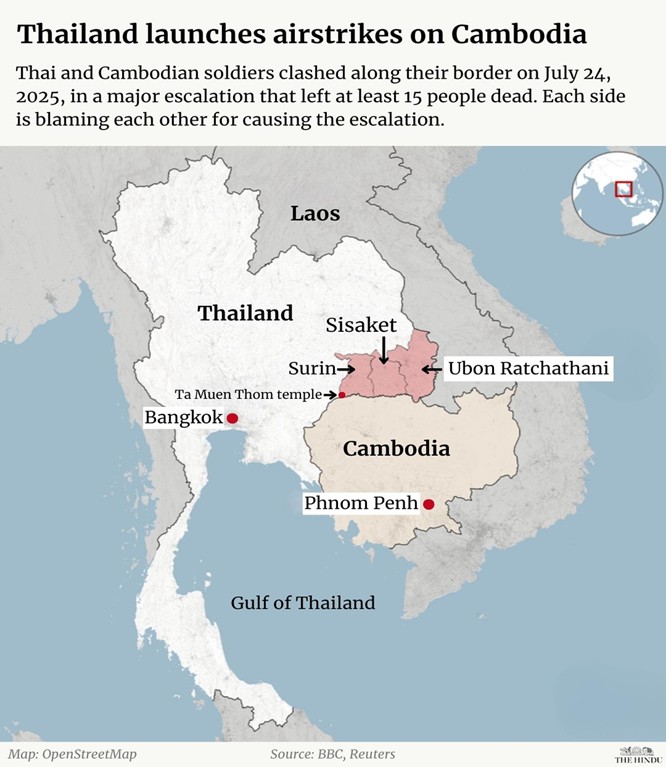
  • Escalation (July 24, 2025): Full-scale fighting broke out on July 24 near the Prasat Ta Muen Thom temple, involving artillery and airstrikes.
  • Wider conflict (July 24–27, 2025): Clashes spread to at least 12 border locations over the next few days, displacing hundreds of thousands of civilians. Thailand reported attacks across several provinces, including Surin, Ubon Ratchathani, Chanthaburi, and Trat.
  • Disputed sites: While skirmishes occurred in multiple areas, the key disputed temple sites are:
    • Preah Vihear Temple: An 11th-century Hindu temple dedicated to Lord Shiva, located atop a cliff in the Dangrek Mountains. The International Court of Justice (ICJ) awarded ownership to Cambodia in 1962 and reaffirmed this in 2013, but the land surrounding it remains contested by Thailand.
    • Prasat Ta Muen: Thom Temple Complex: This 12th-century temple complex is also a key point of contention where some of the July 2025 clashes took place.
Ceasefire and regional involvement
  • Ceasefire agreement: Following intense fighting, both nations agreed to an unconditional ceasefire on July 28, 2025, after talks in Kuala Lumpur.
  • Mediation: The talks were mediated by Malaysian Prime Minister Anwar Ibrahim, with encouragement from the United States and China.
  • ASEAN’s role: The crisis highlighted the limitations of the Association of Southeast Asian Nations (ASEAN) conflict-prevention mechanisms, prompting calls for the regional body to take a stronger role in resolving historical conflicts.
Explanation of Exam Oriented Key Terms
01
Preah Vihear Temple

Preah Vihear Temple is a Khmer Empire-era Hindu temple on the Dangrek Mountains, dedicated to Lord Shiva, and a UNESCO World Heritage Site known for its unique linear design, culminating in a central sanctuary at the summit. It is also at the heart of a territorial dispute between Cambodia and Thailand, with the International Court of Justice (ICJ) ruling it belongs to Cambodia in 1962 and again in 2013, though border tensions persist.

Location and historical context

  • Location:
    The temple is perched on a 525-meter cliff in the Dangrek Mountains, which form a natural border between northern Cambodia and Thailand.
  • Khmer Empire:
    It was constructed primarily during the 11th and 12th centuries during the golden age of the Khmer Empire. Its history, however, dates back to a 9th-century hermitage.
  • Patron kings:
    The temple’s construction began under King Suryavarman I and was expanded by King Suryavarman II, who also built Angkor Wat.
  • Religious dedication:
    Dedicated to the Hindu god Shiva, the temple was later adapted for use by Buddhists.
Architectural features
  • Unique layout:
    Unlike most Khmer temples, which have a conventional rectangular plan facing east, Preah Vihear is built along a long, 800-meter north–south axis.
  • Symbolic representation:
    The temple’s layout and multiple levels represent Mount Meru, the mythical Hindu mountain.
  • Gopuras:
    The complex features five successive gopuras (entrance towers) that increase in elevation and are connected by a system of pavements and stairways.
  • Decorations:
    The temple is celebrated for the exceptional quality and preservation of its intricately carved stone ornamentation, including bas-reliefs.
International dispute and rulings
  • Border conflict:
    Due to its location, the temple has been the focus of a long-standing territorial dispute between Cambodia and Thailand.
  • International Court of Justice (ICJ) rulings:
    • 1962: The ICJ awarded sovereignty over the temple ruins to Cambodia. Thailand accepted the ruling but continued to dispute the surrounding territory.
    • 2013: The ICJ reaffirmed its 1962 decision and ruled that the land surrounding the temple also belongs to Cambodia.
  • UNESCO World Heritage status:
    In 2008, Cambodia successfully registered Preah Vihear as a UNESCO World Heritage Site, which re-ignited tensions and led to military clashes.

PRACTICE QUESTIONS

Consider the following statements regarding the recent Thailand-Cambodia border clashes that erupted in July 2025:

I. The conflict primarily centers around the disputed Preah Vihear Temple, a UNESCO World Heritage Site located in the Dangrek Mountains

II. The roots of the dispute lie in an ambiguous border drawn by the French colonial powers in 1907, which both nations interpret differently

III. The International Court of Justice (ICJ) ruled in 1962 that the surrounding land around the temple belongs to Thailand, a decision reaffirmed in 2013

IV. The recent ceasefire was brokered by the United Nations Security Council with mediation by China

How many of the above statements are correct?

a) Only one
b) Only two
c) Only three
d) All four

Answer: b

Explanation: Statement I is correct: The Preah Vihear Temple (called Phra Viharn in Thai) is a central flashpoint. It is an ancient Hindu temple dedicated to Lord Shiva, built by the Khmer Empire in the 11th century, and is located in the disputed Dangrek Mountains region. It was granted UNESCO World Heritage status as a Cambodian site in 2008, which previously triggered nationalist protests and skirmishes. Statement II is correct: The territorial dispute originates from the lack of clear demarcation along the 800-kilometer border, stemming from a map drawn in 1907 during French colonial rule in Cambodia. Both countries have differing interpretations of this map. Statement III is incorrect: The ICJ ruled in 1962 that the temple itself belongs to Cambodia. In a subsequent 2013 clarification, the ICJ reaffirmed its verdict, stating that the land surrounding the temple also belongs to Cambodia, not Thailand. Statement IV is incorrect: A ceasefire was agreed upon in late July 2025, mediated by the current ASEAN chair, Malaysia, with support from China. The UN Security Council was not the primary mediator.