
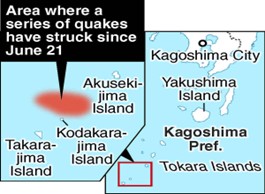
The seismic swarm of over 1,000 earthquakes in Japan’s Tokara Islands during June and July 2025 was caused by volcanic and tectonic activity where the Philippine Sea and Eurasian plates interact. The geological stress was likely exacerbated by the movement of magma beneath the islands.
Key details of the earthquake swarm
- Intense and unusual activity: The swarm began on June 21, and its pace was unusually high and long-lasting compared to previous seismic activity in the region.
- Peak intensity: The strongest quake in the sequence, a magnitude 5.5, occurred on July 3, reaching a “6-lower” on Japan’s seven-stage Shindo seismic intensity scale on Akusekijima island.
- Widespread fear: The constant shaking made it difficult for residents to sleep and led to anxiety about a potential larger earthquake.
- Evacuation orders: Local authorities ordered evacuations for residents of Akusekijima, which has a population of about 90, beginning on July 4. Voluntary evacuations were also conducted from other islands.
- Minimal damage: Despite the intensity of the shaking, no major injuries or structural damage were reported. The quakes caused some rockfalls, landslides, and minor road cracks.
- Ground movement detected: Researchers detected that two small islands, Kodakara and Takara, shifted apart by nearly 10 centimeters in just three days in early July. This is an unusual movement, as the islands typically move in the same direction.
Geological context and Causes
- Magma movement: Experts believe the swarm is linked to volcanic activity in the region. The islands sit in the volcanically active Pacific Ring of Fire, and the movement of magma or underground fluids can create pressure that causes fault lines to fracture.
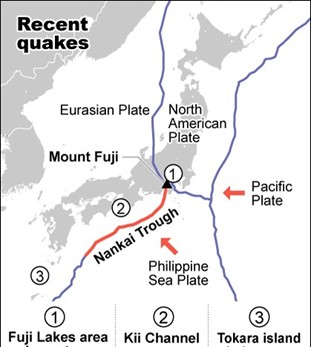
- Tectonic plate interaction: The islands are located where the Philippine Sea plate subducts under the Eurasian plate, leading to significant seismic activity.
- Unrelated to megaquake risk: Seismologists emphasized that this localized swarm was not related to the long-anticipated and more dangerous “megaquake” expected along the Nankai Trough hundreds of kilometers away.
Explanation of Exam Oriented Key Terms
01Geographical context of Tokara Islands |
  |
02Earthquake Swarm |
An earthquake swarm is a series of mostly low-magnitude earthquakes with no mainshock, occurring over days to months in a concentrated area due to fluid movement, active volcanism, tectonic activity, slow-slip events, or human-induced factors like wastewater injection or mining.
Causes of Earthquake Swarms
Characteristics of Earthquake Swarms
Evidence of earthquake swarms
|
 Current Affairs
 Contemporary Issues
 Subject Wise
  Essential Editorials